About Marie
Welcome, and thank you for the compliment of your interest beyond the work and into the artist! Your regard is appreciated as a recognition fueled by an expenditure of attention, energy, and time -- all of which are finite. Hopefully this "About" section will satisfy visitors who arrive with the question "Why concrete poetry?"
(Businesses and individuals people labor painstakingly to create a polished recitation of their biographical facts, achievements, and accolades to craft a presentation of themselves which they label an "About" or "Bio". To find that sort of thing, click here to visit my "Bio" section.)
Why "The Concrete Poet"?
After over thirty years of writing poetry and short stories, a single event wrenched Marie and her art in a new direction. Composing the poem for it demanded the utmost mustering of everything she'd learned up to that point and become as a person along the way. In return, the challenge produced the poem she'd written. Unexpectedly it also forged Marie from a writer and poet who had created it into the concrete poet with a crucial purpose motivated by the implacably finite nature of time.
Early into the pandemic's aftermath -- and caused by it -- members of an Inclusion, Diversity, Equity, and Action group held the company's first annual poetry open mic. Employees ranging from entry-level in any department nearly up to the highest executive level expressed an interest in attending. Attendees and poets would almost all participate from their homes, located in up approximately seven states in four regions of the country. Their level of interest in and knowledge of poetry ranged from casual enjoyment in the genre to enjoyment or recollection of a single poem to interest in the opportunity to step away from their standard work load. All had experienced personal trauma of undisclosed origins over their lifetimes as well as the recent trauma of the pandemic. They had all experienced the pandemic in different ways and carried it differently. They would all attend it with the conscious or unconscious premise that as a workplace event certain personal boundaries would not be crossed, and none of them interpreted the company's recent efforts towards diversity, inclusion, or equity to mean precisely the same thing.
Take a moment to bring a conventional poetry reading to mind. Feel the invisible emotional setting, the general physical details, and the atmosphere.
See yourself as the artist, striving for effectiveness and fill in even more details.
Before:
An organizer, motivated by any number of goals, as reason to hold a poetry reading and sets a date and time. To achieve maximum attendance, they deliberately choose what they calculate as the time the largest number of people will be available and find appealing. They choose the venue the audience pleasant at best, or satisfactory at worst. The event is by definition an opportunity to explore the work of a poet.
People decide to attend because they expect to like the place, the people, and the poetry they expect to find there. They may already know all three from previous experience. They have general expectations based on past experiences and familiar etiquette.
The audience arrives in a flock pattern. The sound level builds from the standard operating levels as they enter, greet others, interact, chat, take their seats, place their coats and bags, and remind each other to silence their phones. They chat in voices lowering in volume by degrees as people reorient themselves subconsciously to adopt a temporary identity: audience member. The sound level hits a low as the audience coalesces.
The host appears, and the audience officially declares its transition. Applause indicates a united sense of positive anticipation and agreement to undivided attention. An intensification of silence respectfully indicates a shared solemn, profound, and complimentary expectation of witnessing something worthy.
With skill, the host greets the audience, confirming their identity. The host alone speaks, having one task: officially complete a transition of roles. The crowd has become an audience. An individual has become the poet who will perform. The host has and may continue to embody the actual venue, the physical stage, and these intangible transitions. One person becomes the reason the everything else. The many have become those who are expected to focus, hopefully witness, and at least remain.
The poet confirms the transition has been made. Perhaps they listen to confirm a sound level that informs them, perhaps the introduce themselves personally to confirm their explicit occupation of the role. Then they begin.
Ideal occupation exists in each role. The event organizer will assemble an audience enthusiastically receptive to the performance. The audience will arrive at peak capacity for receiving and appreciating the performance. The poet will arrive at peak ability to provide a flawless performance. The audience will maintain and avoid any disruptions that hamper the quality of its attention. The poet will provide a flawless performance worthy of the effort and courtesy of that focus.
The audience will respond in a way that compensates the emotional expenditure of the artist in kind, with a palpable expression of appreciation that gives the meaning to the expression "outpouring," in return for what the artist has unstintingly poured into them.
The performer will withdraw, exiting the stage in a manner that maintains role long enough to extend the uniquely enjoyable experience of the audiences as the recipients of something valuable.
The Event
How to do that under these conditions?
The organizer's stated and authentic primary goal was to transform the venue from one that silenced and homogenized attendees to one that instead encouraged interaction and embraced diversity. It set the date and time to achieve maximum attendance for the maximum number of people under obligation to a role of higher precedence than audience member. They chose the venue people would find accessible; their comfort or enjoyment of it was not a factor. Some didn't even like their homes or their offices within them.
People would decide to attend due to obligation, an interest in poetry, to support a coworker, or to step away from something they reckoned less appealing. They'd arrive fresh from other work-related tasks and a world raw with glaring personal and group injuries. None had been to an event precisely like this. A more essential duty than audience focus could call them back at any moment.
The host embodied the role of the venue's owner, not the stage. The role as an event transition between an audience and a performer was a minor detail outside the host's primary skill set, focus, and duty. Their role as a transition between venues and the roles of the participants within it as individuals was even harder; people could lose their jobs if they couldn't keep the roles, boundaries, and obligations clear.
None could confirm their roles because the roles outnumbered the participants. The standard uniting factors of the audience of a poetry reading did not apply. The boundaries everywhere were in flux, and the organizer wanted to sculpt them to better suit all the participants. None of this was wrong. It was new, and everyone chose to be there rather than somewhere else. It was a start.
It was an irresistible challenge. It was the most difficult writing challenge I'd faced up to that date. I succeeding in my writing goals by radically altering my style as an artist. That transformed my identity as a person who spoke her mind as a character trait and created art to satisfy and augment the necessity of breathing.
Afterwards, I emerged as a concrete poet and human being by motivation that emerged from her marrow to communicate. Now it consistently insists, "You must, in this matter and in this manner. You must initiate this discussions. You must channel my neighbor here in your cells, that costly sincerity held at ludicrously low value, to communicate and to exist."
My motivation gives every sign of permanence. It exists now in my cells, only sustained by absolute candor, sincerity, and expression. I must do this as certainly as I must heed the need to breathe, and time is finite.
That is the most succinct, relevant response to curiosity about me as an artist. I doubt any artist can provide a complete one. Time is finite, and we put as many excerpts as we can about ourselves into our work.
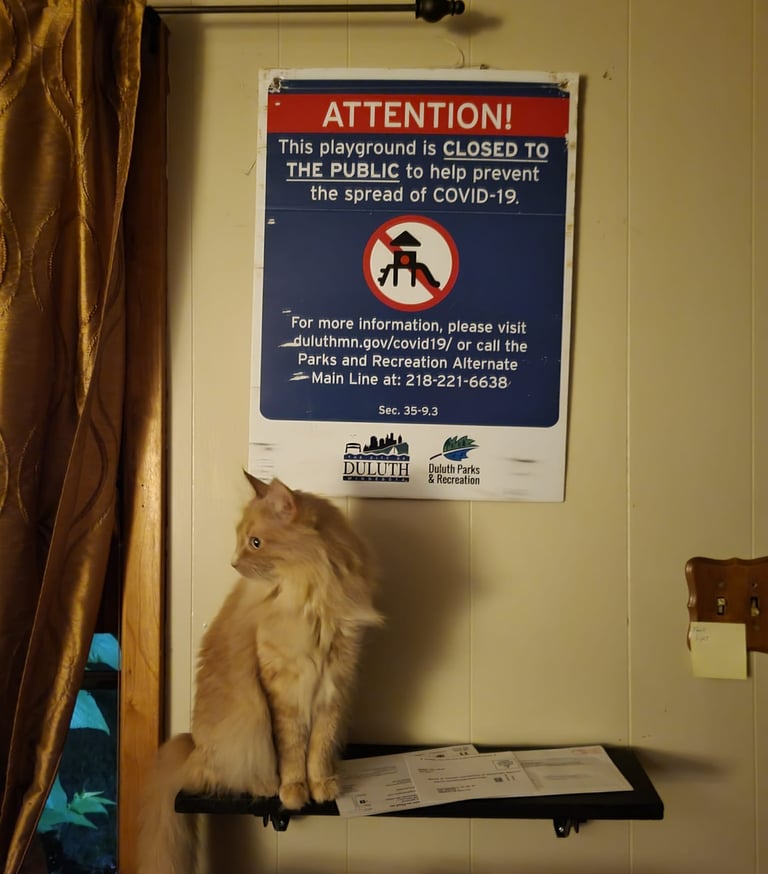
We moved from Duluth, MN to Minneapolis, MN right as everything closed due to the pandemic. The signs at the playground of our old apartment had come loose, and just before we left I found one in our yard. To me, it says one apartment, two houses, two cats who passed, two who were adopted, a pandemic, a surgery, a career change, a major family illness, multiple family losses, my "finally forever home", and so much more. This picture taken shortly before the event, is so much of "during the pandemic." ca. 2023
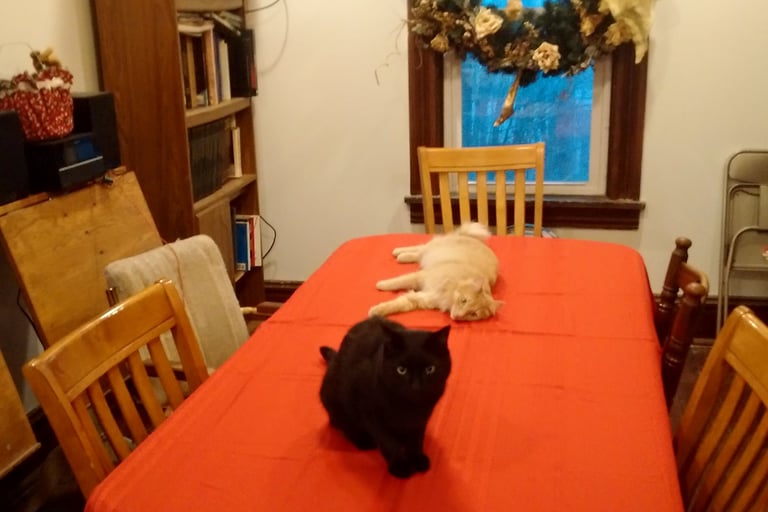
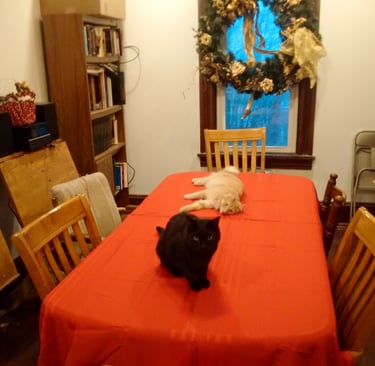
This was "before." Pre-holidays, around 2018, looking the way "Before" always does: calmer, tidier, and easier than it was. Worf (sitting) looks like he knew it a lull between storms to be savored. Gus, just 1 year old, looks like he has no idea what's coming next. I think most people were somewhere between the two for another two years. (Oh, and that antique drafting table with the stereo and holiday decoration on it? My late father and I each had one, and the event inspired me to use is almost as intended.)
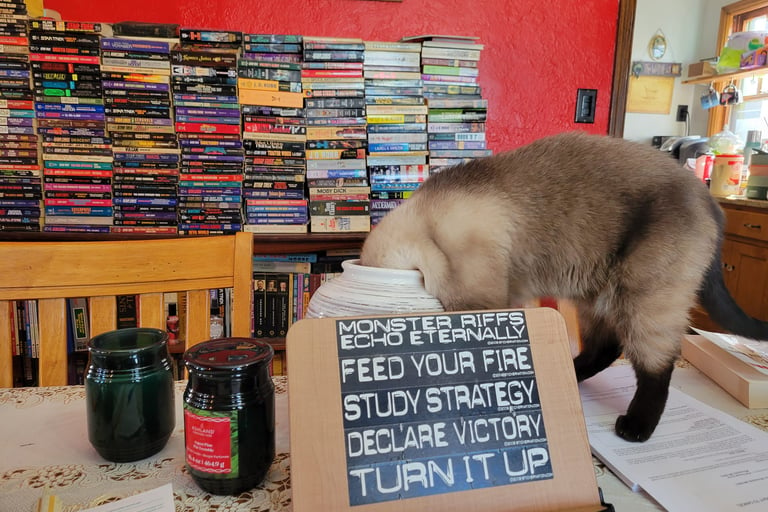
A few years after the pandemic, our family moved to our very own home. An ice dam took out our living room ceiling five months later, and repairs took another three months. On the bright side, since we HAD to choose what color to paint our living and dining room, we DID. That's no small achievement for lifelong renters with no home décor compulsion between them.
The walls looked wall-shaped, the bookshelves looked almost the way they had before, we'd made some improvements, but nothing was quite as sturdy as it looked. We were thrilled to be there, but books would fall a lot of things wouldn't turn out as planned. Sounds familiar.
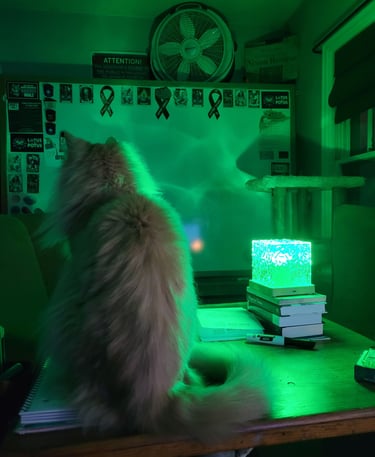
The event was like Von here: a reasonable desire to explore something, a solid plan for doing it, and high aspirations unknowingly working with something that could break at any time, succeed, or both.
And we're doing this. March, 2026.
Contact
Newsletter. News, but better.
Marie@madteamarie.com
© 2026. All rights reserved.
Elsewhere
Shout-outs and Good Stuff
Springboard for the Arts